

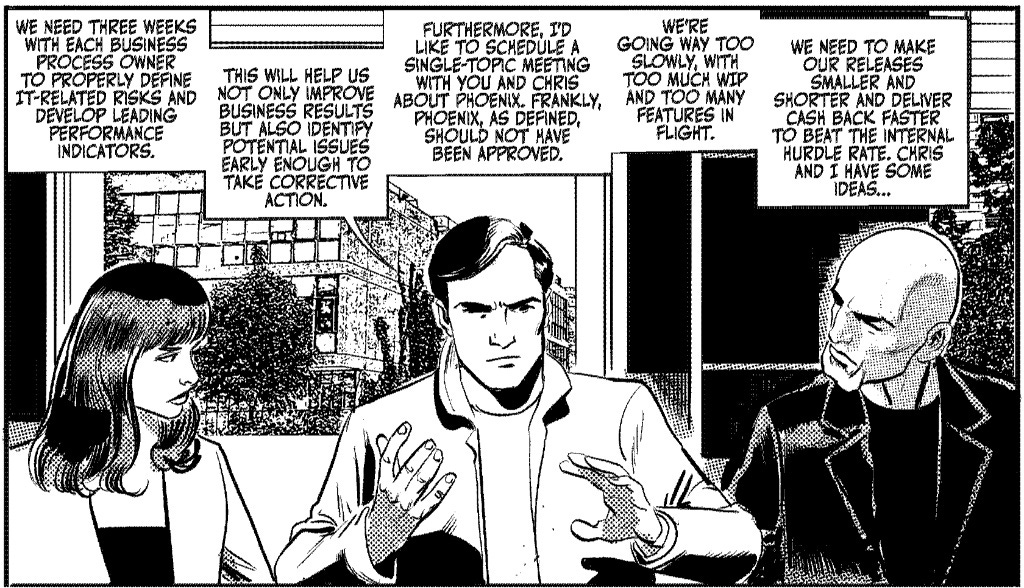
The visual accompanying these lines delivers a clinical diagnosis. It’s an excerpt from the upcoming third volume of the graphic novel based on The Phoenix Project (by Gene Kim, Kevin Behr, and George Spafford). In it, Bill Palmer and his team face a brutal reality: Phoenix, the company’s flagship project, should never have been greenlit. Why? It was built on distant promises of results—with zero immediate guardrails.
As an executive, you’ve likely felt that cold sweat. That specific moment when quarterly financials look green, yet you sense the engine is seizing up. The uncomfortable truth: most of your KPIs are autopsies. They tell you what the organization died of, not how to keep it alive.
This is my daily mission. To lead a modern tech organization, you must stop looking at the rearview mirror and start cleaning the windshield. In short: shift from lagging indicators to leading indicators.
The Tragedy of Retrospective Data
Revenue, net margin, churn rate... these are vital, but they are mere observations. By the time these figures hit your screen, the window for action has closed. Last month is frozen. Steering solely by these metrics is like driving a sports car with your eyes glued to the rearview mirror: at the first sharp turn, you’re in the ditch.
It’s a psychological trap. Lagging indicators feel safe because they are precise. They look great in an investor deck. But they are passive. Conversely, leading indicators are predictive. They measure the activities and conditions that statistically guarantee future success.
If you’re chasing growth, don’t just stare at the balance sheet. Monitor your pipeline velocity or sales response times. Is user satisfaction your priority? Stop obsessing over churn rate—track weekly engagement on core features instead. The signal is there, hidden in the shadows, long before the financial hit happens.
Conway’s Law and the Architecture of Silence
We often ignore a fundamental law: your team structure dictates your product quality. Tech systems inevitably mirror the communication patterns of the organizations that build them. That’s Conway’s Law. If your departments work in silos, your software will be fragmented, slow, and brittle.
Here, the leading indicator is flow. How much time elapses between an idea and its market launch? If this lead time is stretching, it’s not because your people aren’t working hard—it’s because your organization has become an obstacle. An autonomous team with end-to-end ownership will always out-deliver a group of isolated geniuses. Your company topology is your primary profit lever.
Escaping the Feature Factory
The obsession with shipping features is a costly disease. Welcome to the Feature Factory: a mill churning out volume to create the illusion of progress without ever questioning actual value. We stack options hoping to impress, but we only add technical debt and invisible maintenance costs.
True excellence lies in generating Global Impact. To get there, you must pull strategic levers that turn simple production into a value engine:
Outcome over Output: Focus on business benefits rather than lines of code.
Developer Experience (DevX): Remove friction to unlock engineering creativity.
Design for Failure: Build resilient architectures that survive errors.
Flow Alignment: Structure the org so nothing slows the path to the customer.
True Empowerment: Push decision-making to the “edge,” where the technical knowledge lives.
Operational Efficiency: Ruthlessly hunt the waste slowing your internal processes.
Cash-Flow Acceleration: Ship tiny increments to generate immediate ROI.
In the Phoenix Project comic, a character drops a hard truth: “We must reduce release sizes to beat the internal rate of return.” It’s math. Every day a piece of value is “done” but not “shipped” is a day you pay interest on invisible debt.
Cognitive Load: The Silent Killer
There is one metric few boards dare to track, yet it defines your viability: the cognitive load of your teams.
An organization where talent is saturated by bureaucracy or overly complex tools stops creating. If your teams spend 60% of their time in “sync meetings,” your flow is dead. The role of a proactive leader is to be an architect of simplicity. This requires the courage to say “no” to a brilliant but resource-heavy idea to protect your overall capacity to innovate.
Towards Signal-Based Governance
Moving to leading indicators requires a radical cultural shift. You must accept a degree of uncertainty regarding final numbers to focus on mastering the initial levers.
A senior leader doesn’t ask, “Why did we miss the goal?” They ask, “What obstacle is blocking movement today?” This shifts leadership from “Controller” to “Value Unblocker.”
Your ideal dashboard should look like a weather station. It should warn you of incoming storms, not send you a postcard after the hurricane has passed. By monitoring precursor signals—intrinsic work quality, resolution speed, boots-on-the-ground satisfaction—you regain control over your economic destiny.
Performance isn’t a destination you observe; it’s a movement you maintain. Those who master the art of anticipation don’t just endure the future—they write it.